Darhon Rees-Rohrbacher holds Bachelor, Master and Doctor of Music degrees in Vocal Music. Initially trained as a classical vocalist and pianist, she began her harp studies after moving to Upstate New York and has since followed a multi-faceted career path. Her harp playing has taken her from the most formal orchestral concerts to very intimate chamber performances wearing historical costume. Her vibrant singing voice has been heard in numerous stage productions, recitals, concerts and competitions in the United States and abroad. In addition to being a well-known arranger whose harp publications are sold internationally, she is an experienced choral conductor, concert organizer, arts advocate, music journalist and music educator. She gives private instruction at her home in piano, voice and harp and performs extensively in the Northeastern U.S.A. Darhon also pursues her interest in healing as a registered nurse.
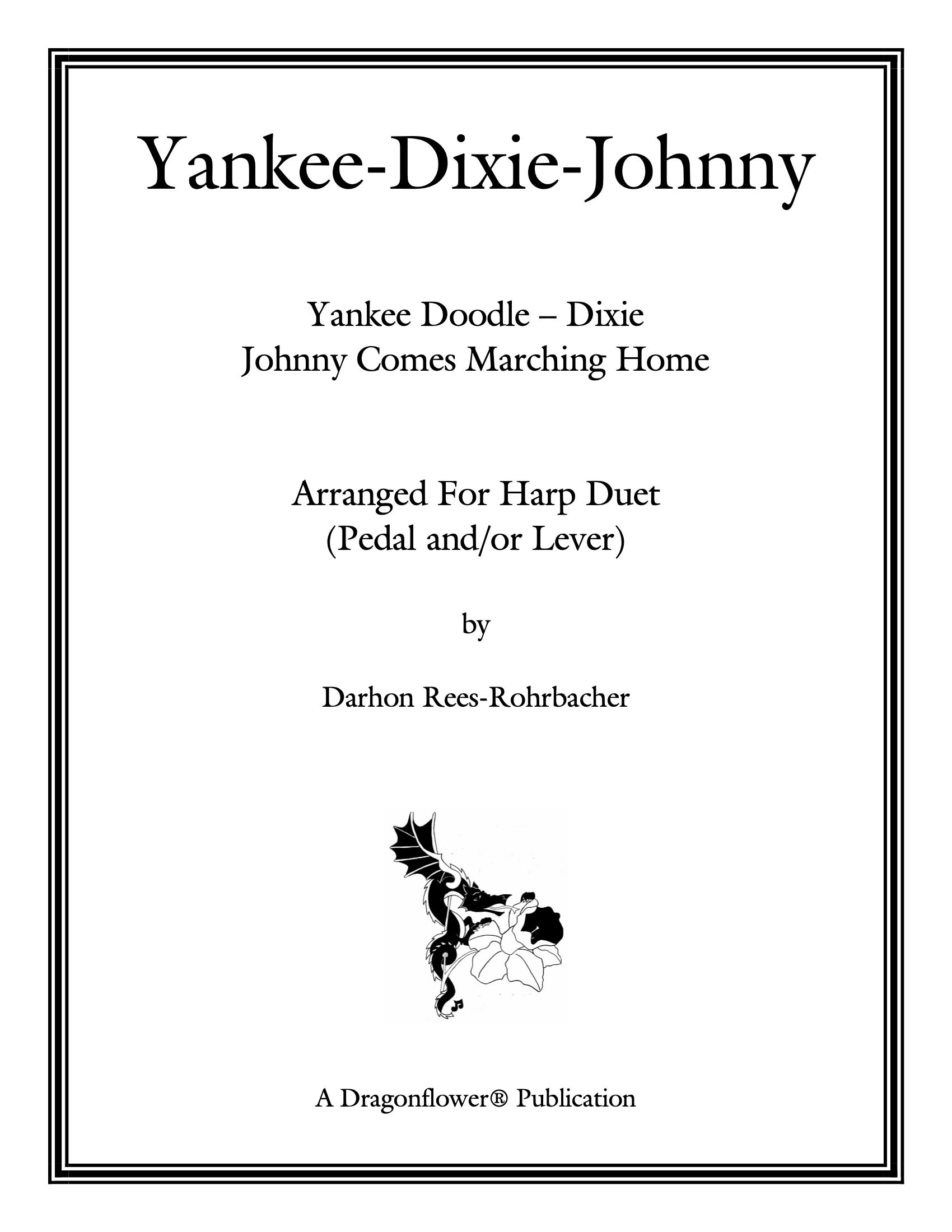
The Yankee Dixie Jonnie
$10.00
| PDF or LHS | Downloadable |
|---|---|
| Difficulty Level | Intermediate |
| Harp Type | Lever Harp, Pedal Harp |
| Traditional Music |
Yankee Doodle, first heard in 1755 (Richard Shackburg, exact life dates unknown)
The origin of this tune is a subject for debate, but it probably predates the American Revolution by at least 125 years. The Spanish, Dutch, Germans, Hungarians, and the English have all claimed this tune as their own. “Yankee” was a term of contempt used for the Puritans, while “doodle” meant a simple fellow. The tune may have been adapted from an earlier British folk song called Nancy Dawson. The colonial words are said to have been written by an anonymous gentleman from Connecticut.
In 1755 during the French and Indian War, Dr. Richard Shackburg, a member of the British Army, taught the colonial soldiers the words and music of Yankee Doodle, telling them it was a “fine military march.” This was intended as a joke, because of the rag-tag, unkempt appearance of the American colonists serving in the militia. Reportedly, the British were very amused when they heard the tune sung by the ill-dressed colonists. But the joke failed when the song became the victory march of the Revolutionary War.
Dixie, first heard in 1859 (Daniel Decatur Emmett, 1815-1904)
In 1859, Daniel Decatur Emmett of Mount Vernon, Ohio was a member of the touring company “Bryant’s Minstrels.” As resident composer for the company, he was asked by Mr. Bryant to provide a new song for the upcoming performances, and Mr. Emmett presented the words and music to Dixie the following week. The song became a hit and after its debut in a New Orleans performance in 1860, Dixie became the inspirational song of the Confederate Army.
Johnny Comes Marching Home, first heard in 1863 (Patrick Sarsfield Gilmore, 1829-1892)
Irish-born musician Patrick S. Gilmore first emigrated to Canada and then to Massachusetts. He became the U.S. Army bandmaster during the Civil War and, under the nom de plume of “Louis Lambert,” composed this tune. In addition to being a famous bandleader, Mr. Gilmore was a promoter and organizer of several large music festivals. Interestingly, his tune is very similar to the Irish song Johnny I hardly knew ye. As to which song came first, it is anybody’s guess.